 OSRS Calc
FIELD GUIDE · activity
OSRS Pest Control Points and Void Set Calculator
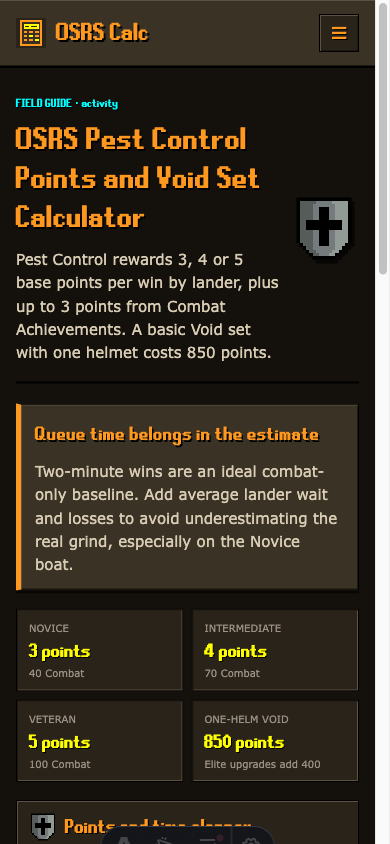
Pest Control rewards 3, 4 or 5 base points per win by lander, plus up to 3 points from Combat Achievements. A basic Void set with one helmet costs 850 points.

Queue time belongs in the estimate
Two-minute wins are an ideal combat-only baseline. Add average lander wait and losses to avoid underestimating the real grind, especially on the Novice boat.
 Points and time planner
Include queue time and failed rounds in minutes per win; the planner rounds games up.
Points per win
The three landers award 3, 4 and 5 base commendation points. Easy, Medium and Hard Combat Achievement tiers add 1, 2 or 3 points per win respectively. The activity bar must remain above zero to receive rewards.
A top, robe, gloves and one helmet cost 850 points. Upgrading the top and robe to Elite Void costs another 400 points after the Hard Western Provinces Diary.
Time, not just games
Official-world games are often completed in under two minutes, but lander countdowns and failed rounds change elapsed time. Use the on-page calculator with your observed average instead of multiplying by a best-case figure.
Choose the lander from your actual account
Pest Control is gated by combat level, so the first decision is whether your account can board Novice, Intermediate or Veteran. A higher lander gives more points per win, but only if you can join its queue and complete rounds reliably. A theoretical five-point rate is not useful when the account is limited to the four-point boat or when failed rounds erase the advantage.
Use the combat-level calculator linked below to confirm the unlock before setting a points target. Then enter the points per win you actually receive, including Combat Achievement bonus points, rather than the maximum lander value you have seen in a guide.
- Confirm combat level and lander access before calculating games.
- Add the correct Easy, Medium or Hard Combat Achievement bonus only when completed.
- Measure a full cycle including the queue, countdown, game and reward screen.
- Keep failed rounds in the average; they are part of the grind you are planning.
Example points and time calculation
A Veteran win provides 5 base points. If your completed achievement tier adds 3, each successful game gives 8 points, so an 850-point target needs 107 wins after rounding up. At a measured 3.5 minutes per completed cycle, that is about 6.2 hours before failed games and breaks. The same target at 4 points per win needs 213 wins, which is why access to a higher lander can matter more than a small improvement in combat speed.
The numbers are examples for the planner. Replace the cycle time with your own observed average because public worlds, queue length and team behaviour change it throughout the day.
Point targets beyond the first Void set
Plan the full target before spending points. A one-helmet Void set costs 850 points, while an Elite top and robe require an additional 400 points and the diary unlock. If you buy a second helmet or other reward first, the number of games for the final combat goal changes. List each purchase, its point cost and the order in which it becomes useful.
Void can also have account-specific value. A main may value immediate combat utility, while an iron account may value the time saved by obtaining a set that works across several activities. Keep that progression value separate from a cash-per-hour estimate.
Use observed pace for a trustworthy answer
Time at least one complete block of games rather than timing a single fast win. Include the queue, lander countdown, game, reward screen and any failed round. If your observed cycle is 20 percent slower than the ideal two-minute value, apply that slower pace to every target in the planner. The estimate then remains useful when the queue changes or a team is less coordinated.
Recalculate after reaching a higher combat level or completing another Combat Achievement tier. The point rate may change, and the order of Void purchases can change with it. Keeping the inputs visible makes the planner a small progress log instead of a one-time answer.
Check your combat level
Confirm which lander your account can board before choosing its point rate.